Data Residency for Voice AI: Why Your Region Decides Your Voice
For a regulated voice AI deployment, data residency is not only a storage rule. It quietly decides which models and voices you can use, because a managed provider's catalog is not identical in every region: the flagship voice in the demo may not exist in the region your rules require. At taritas we hit this directly. The natural managed voice we wanted was not available in our client's required region, so we self-hosted an open model in-region to keep both residency and quality, then moved back once the managed voice reached that region in early 2026. The practical rule is to pin the region first, audit what is actually available there, and treat self-hosting in-region as the escape hatch when the managed catalog is thin. Budget for that escape hatch, because in-region self-hosting adds a GPU operations program that a managed voice would otherwise have absorbed for you.
Published · Updated · Supreet Tare
All names, numbers, and identifiers in this post are anonymized. The patterns are real.
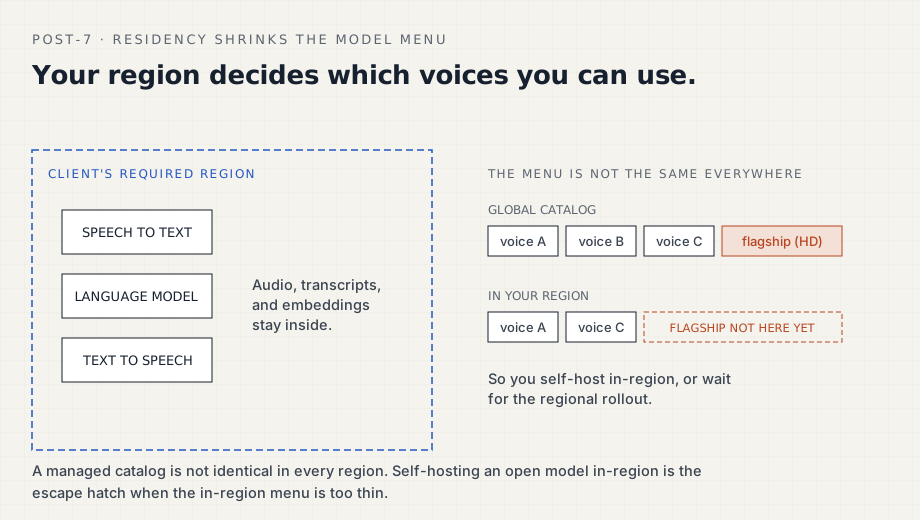
A residency requirement usually arrives sounding like a storage decision: the client’s audio and transcripts must never leave the country. On one production deployment, that single rule quietly decided something we did not expect. It decided which voice our agent was allowed to speak with. Here is how residency actually constrains a voice AI build, and the framework we now use so it does not surprise us.
Is data residency only about where data is stored?
For a voice agent, residency means every stage of the call runs inside the required region: speech-to-text, the language model, and text-to-speech, plus any storage and logging. Audio, transcripts, and the embeddings derived from them stay inside the boundary, and nothing crosses it.
The part teams miss is that text-to-speech is part of that data path. The text you send to be synthesized can contain personal information (a name, an address, a case detail), so the speech engine sits inside the residency boundary like everything else. That means your choice of voice is governed by what is available in your region, not by the global catalog you saw in the demo.
Why is the voice catalog in your region smaller than the demo?
Managed providers do not ship every model in every region at the same time. The flagship, most natural voice is often available in a few large regions first and reaches the rest later. So when your residency rule pins you to a specific region, the menu of voices and models you can actually use shrinks, sometimes well below what the marketing page implies.
We ran straight into this. The natural managed voice we wanted was not available in our client’s required region. The voices that were available there did not sound natural enough for a citizen-facing line. Residency and quality were in direct conflict, and residency is not negotiable.
When should you self-host a voice model in-region?
The way out was to self-host an open model on a GPU inside the required region. That keeps residency intact (the model runs where the data must stay) and lets you pick a model good enough on quality, at the cost of running the infrastructure. We did exactly that: an open model in-region cleared the quality bar, the audio stayed inside the boundary, and we paid for it in GPU capacity and operations rather than in a per-character fee. The full engine-by-engine tradeoff is in our self-hosted-versus-managed TTS comparison; the residency point here is narrower: self-hosting decoupled our model choice from the provider’s regional rollout.
Then the managed catalog caught up. The HD voice we had wanted reached our client’s region in early 2026, it cleared quality, and we moved back to it, dropping the self-hosted GPU. Residency had forced the detour; a regional rollout ended it.
The framework we use now
Four steps, in order:
Pin the region first, before choosing any model, because residency is the hard constraint everything else fits inside. Audit what is actually available in that region across all three layers (speech-to-text, language model, text-to-speech), and expect it to be a smaller list than the global one. Treat self-hosting in-region as the escape hatch when the managed catalog there cannot meet quality, accepting the operations cost as the price of keeping residency and quality at once. And re-audit each generation, because the managed catalog expands by region over time, and the option that was missing last year may be the cheapest right answer this year.
What this means if you are an IT services firm
When you sell voice AI into a regulated client, their security review will ask where the data lives, and the honest answer has to cover the whole pipeline, including the voice. Being able to say “audio, transcripts, and embeddings stay in your region, every model runs in-region, and here is our plan when a model we want is not available there yet” is the kind of specific, built-for-it answer that passes a procurement review instead of stalling in it. Carrying that answer for partners is a large part of how we work.
Reading this because a client asked for voice AI? That is the conversation we are built for. What taritas does for partners.