What Security Features Should an Enterprise Voice AI Have?
An enterprise voice AI needs security features at every hop of the call, because a voice pipeline has more moving parts than a web app: carrier, speech to text, language model, text to speech, and the backend that ties them together. The checklist we build to at taritas: encryption in transit and at rest on every hop, authenticated internal endpoints with constant-time secret checks, role-based access to the admin surface, tenant isolation in the knowledge base, redaction of sensitive strings before text reaches the model or the voice, per-turn audit logging with cost and latency metering, rate limits and business-hours gates enforced in code, and safety escalation that notifies a human exactly once, enforced at the database layer. Compliance controls like data residency and signed BAAs sit on top of the engineering, not in place of it. A serious vendor can show each feature working in production, including a security review report with real findings.
Published · Updated · Supreet Tare
All names, numbers, and identifiers in this post are anonymized. The patterns are real.
The search query behind this post
Buyers type it almost as a sentence: need enterprise voice AI with end-to-end encryption. Encryption is the right instinct and the wrong place to stop. It is one line of a checklist, and a vendor can satisfy it while failing every other line. This post is the full checklist we build to, with the production details that make each line real. We build voice agents for public-sector and healthcare clients, so every feature here exists because a reviewer, a regulator, or an incident demanded it.
A voice pipeline has more doors than a web app
A standard voice agent moves your caller’s words through a carrier, a speech-to-text engine, a language model, a text-to-speech engine, and the backend that orchestrates them. Each hop is a data flow, usually to a different vendor, and each vendor is a door. That is why voice AI security is not one feature. It is the same short list of disciplines applied at every door. The vendor-agreement half of that story, which vendors will sign a BAA and where the coverage gaps hide, is in which voice AI subprocessors sign a BAA. This post is the engineering half.
1. Encryption on every hop, and honesty about “end-to-end”
Every connection in the pipeline carries TLS: carrier to pipeline, pipeline stages to each other, agent to backend. Recordings, transcripts, and the knowledge base are encrypted at rest. That part is table stakes.
The honest caveat: true end-to-end encryption is not possible in this architecture, because the speech-to-text, model, and voice services must process the content to function. What replaces it is minimizing what each hop keeps: zero-retention and no-training flags at each vendor, and retention schedules enforced in code on your own side. A vendor who promises literal end-to-end encryption on a standard pipeline is describing marketing. The compliance framing of these controls lives in our HIPAA and GDPR compliance pillar.
2. Authenticated internal endpoints, verified in constant time
The agent process talks to the backend over internal APIs: writing flags, posting transcripts, updating session state. Those endpoints authenticate with a shared secret, and the comparison is constant-time, so the check does not leak information through timing. We did not always have that: a structured security review on a healthcare launch found a high-severity authentication bypass on exactly this surface, fixed and test-verified the same day. The full account, including why we handed the client the report with the findings still in it, is in can voice AI pass a healthcare security review. The lesson generalizes: the agent-to-backend seam is the most commonly forgotten attack surface in a voice deployment.
3. Least privilege everywhere the data lands
Role-based access on the admin surface, so recordings and transcripts are visible only to the roles that need them. Tenant isolation in the knowledge base, so one client’s documents can never surface in another client’s call. Links in alert emails are built server-side from IDs, never from user-supplied text. None of this is exotic. All of it gets checked in a serious procurement review.
4. Redaction before the model and before the voice
Two redaction layers, at different points, for different reasons. Sensitive identifiers are stripped from knowledge base results before the model sees them, so the model cannot recite what it was never shown. And a deterministic output filter scrubs every assistant message on its way to the voice, as the last line. The subtlety is preserving the audit trail while you redact: the raw text stays in a separate audit buffer so evaluation can still trace answers to sources. That design, and the production bug that forced it, is in redacting a voice agent’s own knowledge base.
5. Audit logging you can act on
Every turn is logged with a full latency and cost breakdown per stage: speech-to-text, safety check, retrieval, model, voice. The safety check is a metered line item, visible per turn, so we can say exactly what safety costs in milliseconds and dollars rather than hand-waving it. Session-level safety flags are written the moment they trigger. And after every call, an evaluation scores each assistant answer for faithfulness against the knowledge base results the agent actually used. When a client, a reviewer, or our own team asks what happened on a call, the logs answer.
6. Abuse and cost controls enforced in code
A daily rate limiter in Postgres caps call volume atomically, so a burst of concurrent calls cannot race past the cap; the implementation is in one UPDATE for a race-free daily rate limit. A business-hours gate inside the transfer tool refuses to forward calls when no one is there to receive them. These live in code, not in the prompt, because a failure here is not something to ask a language model to avoid. It is something to make impossible.
7. Safety escalation that fires exactly once
This is the feature that decides whether a voice AI can be trusted around vulnerable users, and it is where our freshest production detail comes from: a healthcare deployment where the agent talks to patients with no clinician on the call, and must notice a user in crisis.
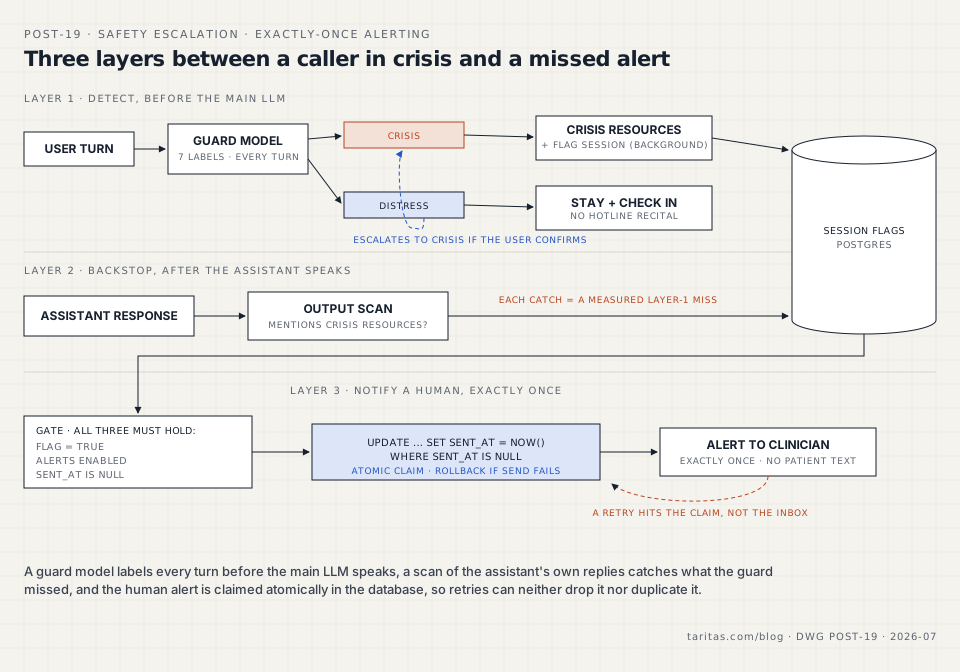
The architecture is three layers, each catching the failure mode of the one above it:
Layer 1, a guard model on every turn. A small fast model labels each user turn with one of seven labels before the main model responds. A crisis label halts normal content, switches the agent to crisis resources, and flags the session in the database through a background write that does not make the caller wait. The taxonomy also has a separate distress label for users who are struggling but not in crisis: the agent stays with them and checks in, without reciting hotline numbers at someone who is sad but safe, because over-alerting is its own harm. If the user then confirms they are in crisis, the label escalates and the full protocol fires.
Layer 2, a scan of the assistant’s own output. Every assistant response is checked for crisis-resource mentions. If the main model responded like it heard a crisis the guard model missed, the session still gets flagged. Detecting a caller’s crisis language is hard and unbounded; detecting the assistant’s response to it is easy, because that vocabulary is small and finite. The generator becomes the sensor. Each Layer 2 catch is also a measured Layer 1 miss, which gives us a free evaluation signal in production.
Layer 3, a human alert that can neither drop nor double. A flagged session emails the clinician, gated by three conditions and claimed atomically at the database:
UPDATE sessions
SET alert_email_sent_at = now()
WHERE id = $1
  AND alert_email_sent_at IS NULL;
-- send the email only if this claimed exactly one row;
-- roll back the claim if the send fails, so it can retry
A retried request cannot double-email the doctor, and a failed send can try again. The email body contains only the session ID, the language code, and a server-built link. No patient text enters the message, which removes both the injection surface and the protected health information from the inbox. A clinician who gets three alerts for one session stops trusting the system; one who gets zero misses a patient. Exactly-once is the whole feature.
8. Compliance controls sit on top
Data residency that pins audio, transcripts, and inference to an approved region is an architecture decision, made early; we wrote about how it constrains everything else in data residency decides your voice AI. BAAs and DPAs per subprocessor, retention schedules, and the register procurement will ask for are covered across our compliance posts. The order matters: the paperwork describes the controls. It does not substitute for them.
How to tell a secure provider from a brochure
If you are evaluating providers of secure voice AI infrastructure, four requests separate them quickly. Ask for a security review report with real findings and fixes in it. Ask for the subprocessor register. Ask to see per-turn audit logs from a production system, including the metered cost of the safety checks. And ask what happens to their alerts and webhooks under retries. The last one sounds obscure and is the fastest tell of the four: exactly-once thinking either runs through a system or it does not.
Key takeaways
Voice AI security is the same short list applied at every hop: encrypt it, authenticate it, least-privilege it, redact it, log it, cap it, and escalate to a human exactly once. End-to-end encryption on a standard pipeline is a marketing phrase; encryption on every hop with zero-retention flags is the real requirement. Safety features must be metered like any other feature, so you know what they cost. And the controls procurement reads about must be the controls engineering built.
What this means if you are an IT services firm
When your client asks whether a voice agent is secure, this checklist is the conversation, and every line of it is demonstrable: show the encrypted hops, show the constant-time check, show the redaction layers, show a turn’s audit log, show the atomic claim that makes an alert fire once. Systems that were built to pass a review can always show their work. If you are scoping a voice AI deployment for a client who will face this kind of review, this is the work we do with partners every week: what taritas does for partners.
Reading this because a client asked for voice AI? That is the conversation we are built for. What taritas does for partners.